
Stressonika / Protocol
Protocol
The same session for everyone.
Stressonika is a fixed sequence of breathing, tasks and rest. The voice instructions, the timing and the order are built into the test, so differences between sessions come from the person and their day, not from the procedure. That is what makes a session comparable with the norms and with the person's own last session.
The sequence
Durations are typical values from 2,879 recorded sessions. A whole session takes a median of 23.7 minutes; nine sessions in ten take 22.4 to 25.6.
| # | Section | What the person does | Duration | What it shows |
|---|---|---|---|---|
| 1 | Paced breathing, eyes open | Breathes to a guide: in for 3 s, hold 0.5 s, out for 6 s, hold 0.5 s, about six breaths a minute | 60 s | How far the heart rate swings with each breath |
| 2 | Paced breathing, eyes closed | The same rhythm with eyes closed | 60 s | The same swing without visual input; alpha rhythm on the facial channels |
| 3 | Tapping | Taps as fast as possible; the voice asks for more after the 35th and the 105th tap | about 35 s | Motor tempo, endurance, steadiness; how steeply the heart rate rises |
| 4 | Stroop 1 | Presses only when a colour word matches its ink colour, holds back otherwise | 60 s | Holding back the wrong press under interference |
| 5 | Stroop 2 | The same task while keeping a moving target in the controller's sight | 60 s | Tracking under divided attention |
| 6 | Self-rating | Rates how well the task just finished went | 10–20 s | How the person judges their own result |
| 7 | Rest break 1 | Sits quietly and lets go | 120 s | Whether the heart comes down when nothing is asked |
| 8–12 | Schulte tables ×5 | Finds the numbers 1 to 25 in order on a 5 × 5 grid, five times | about 40–45 s each | Visual search speed and how even it stays |
| 13 | Self-rating | As above | 10–20 s | As above |
| 14 | Rest break 2 | As in rest break 1 | 120 s | Recovery after the second block of load |
| 15–16 | Banana test | Picks only the right word–colour pairs on a 4 × 6 grid of food words that changes every 8 s, after a short practice | about 35 s + 4 min | Productivity, precision and flexibility under time pressure |
| 17 | Self-rating | As above | 10–20 s | As above |
Why this order
The session starts with breathing, so the body's own range is measured before any task. The load then comes in two blocks, each followed by a rest break: the first block shows how fast the person switches into load, the breaks show how fully they switch off. Motor, attention and choice tasks follow each other, so the load is varied rather than one long effort.
Paced breathing at about six breaths a minute with a long exhale is the standard way to bring out the heart's breathing swing (heart rate variability biofeedback, resonance breathing).
The tasks behind the tasks
Three of the tasks are VR versions of established tests of attention and speed; the fourth is our own choice task:
- Finger tapping, here at maximal speed: motor tempo, which is linked to processing speed.
- Stroop, in a go/no-go form: the person presses only when the word and its ink colour match, so the interference between reading and colour has to be held back.
- Schulte tables: visual search and the stability of attention.
- Banana test: our choice task under time pressure, followed by a self-rating that shows how well the person judged their own result.
Settings
Before the session the operator chooses the language (English, French, Greek, Polish or Russian), and the person's dominant hand. The report is built from the full sequence.
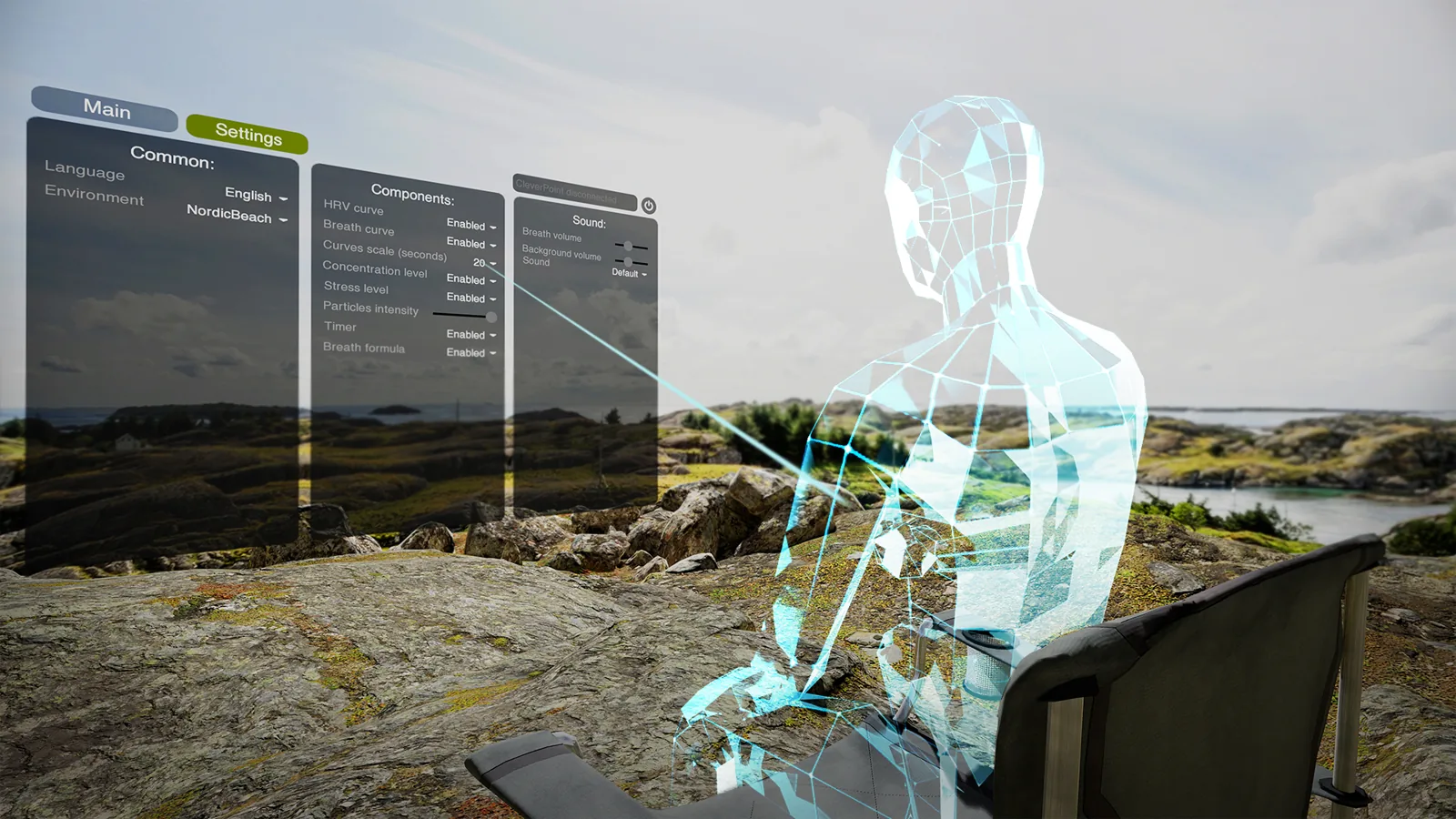
The operator's part
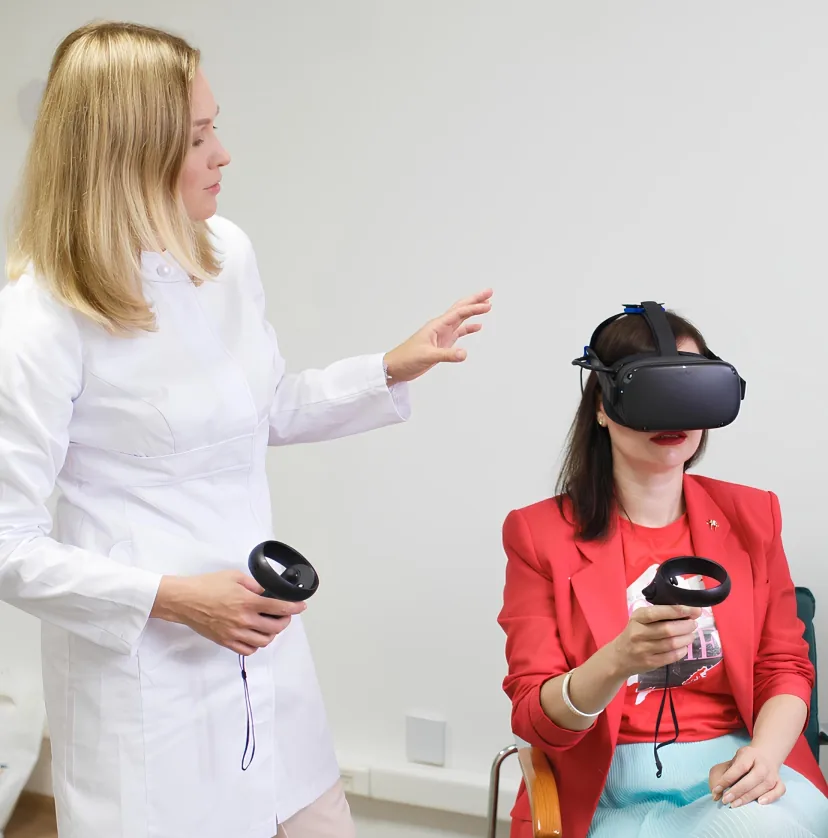
The person sits, wears the headset with CleverPoint 4 and holds the controllers. The operator at the PC starts the session in EVA, checks the signal of each electrode and watches the recording. EVA marks the start and end of every section on the recording's clock, so each measure is computed on exactly its section.
Literature
- Stroop JR. Studies of interference in serial verbal reactions. J Exp Psychol. 1935;18(6):643–662.
- MacLeod CM. Half a century of research on the Stroop effect: an integrative review. Psychol Bull. 1991;109(2):163–203.
- Baudouin A, Vanneste S, Isingrini M. Age-related cognitive slowing: the role of spontaneous tempo and processing speed. Exp Aging Res. 2004;30(3):225–239.
- Lutsyuk N, Éismont E, Pavlenko V. Correlation of the characteristics of EEG potentials with the indices of attention in 12- to 13-year-old children. Neurophysiology. 2006;38(3):209–216.
- Lehrer PM, Gevirtz R. Heart rate variability biofeedback: how and why does it work? Front Psychol. 2014;5:756.
- Lehrer P, Vaschillo B, Zucker T, et al. Protocol for heart rate variability biofeedback training. Biofeedback. 2013;41(3):98–109.
- Vaschillo EG, Vaschillo B, Lehrer PM. Characteristics of resonance in heart rate variability stimulated by biofeedback. Appl Psychophysiol Biofeedback. 2006;31(2):129–142.