
Table of Contents
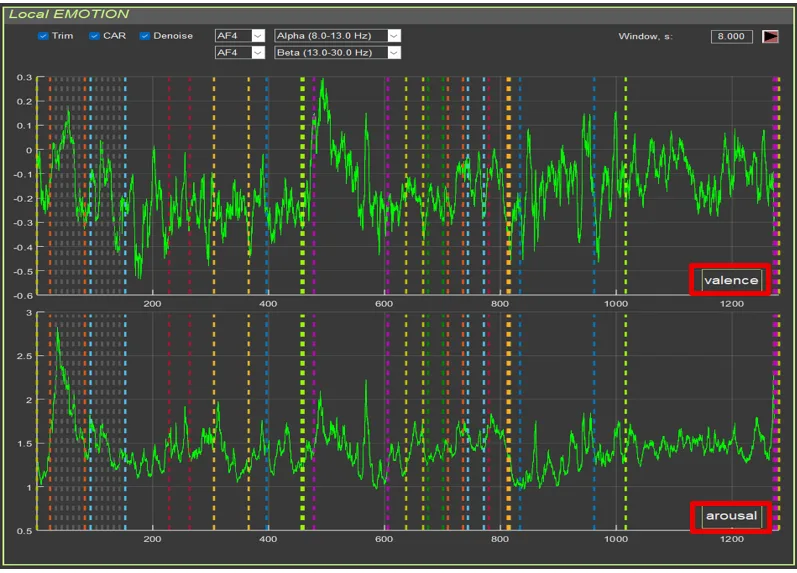
7.5.1. Local EMOTION #
Two graphs:
- Arousal: arousal time series (green line)
- Valence: valence time series (green line)
Both graphs are synchronized in time and contain section markers.
7.5.2. Integral EMOTION #
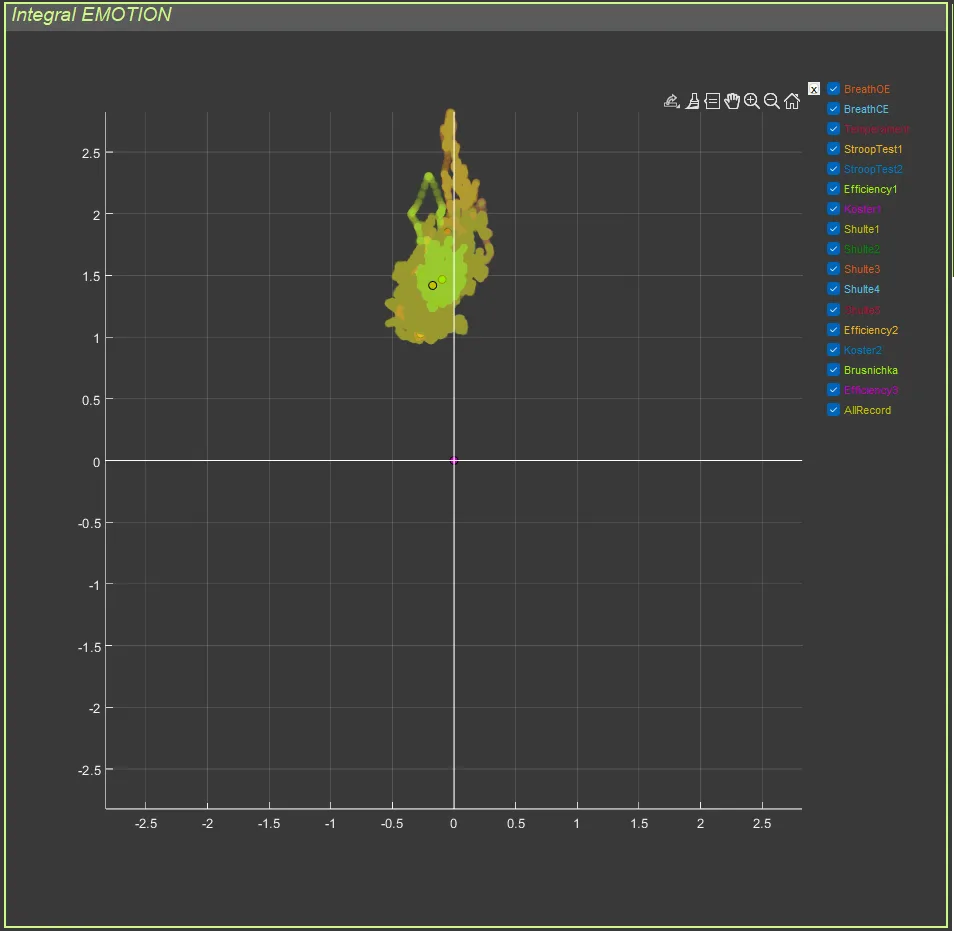
Scatter plot:
- X-axis: Valence
- Y-axis: Arousal
- Points: each point represents one moment in time
- Colors: different sections have different colors
- Large points: median values for each section
Emotion quadrants:
- Upper right (high valence, high arousal): joy, enthusiasm
- Upper left (low valence, high arousal): anxiety, anger
- Lower left (low valence, low arousal): sadness, depression
- Lower right (high valence, low arousal): calmness, satisfaction
Physiological explanation of the emotion quadrants:
Upper right quadrant (High valence + High arousal):
- Emotions: joy, enthusiasm, excitement, delight
- Physiology:
- activation of the left hemisphere (positive emotions)
- high beta activity (active thinking)
- increased sympathetic activity, but in a positive context
- dopamine and endorphin release
- Behavior: activity, goal-directed behavior, positive motivation
Upper left quadrant (Low valence + High arousal):
- Emotions: anxiety, anger, fear, panic
- Physiology:
- activation of the right hemisphere (negative emotions)
- high beta activity (stress, tension)
- high sympathetic activity (“fight or flight” response)
- cortisol and adrenaline release
- Behavior: avoidance, defense, aggression
Lower left quadrant (Low valence + Low arousal):
- Emotions: sadness, depression, apathy, gloom
- Physiology:
- activation of the right hemisphere (negative emotions)
- low beta activity (reduced cognitive activation)
- high alpha activity, but in a negative context
- reduced sympathetic activity
- possible neurotransmitter imbalances (serotonin, dopamine)
- Behavior: passivity, avoidance, reduced motivation
Lower right quadrant (High valence + Low arousal):
- Emotions: calmness, satisfaction, relaxation, peacefulness
- Physiology:
- activation of the left hemisphere (positive emotions)
- high alpha activity (relaxation)
- low beta activity (absence of stress)
- high parasympathetic activity
- balanced autonomic nervous system
- Behavior: rest, recovery, positive relaxation
Important:
The quadrants are conditional and show not absolute emotions, but changes in emotion:
- left to right: from less positive to more positive (or less negative)
- bottom to top: from weaker to stronger
Emotion dynamics:
- Emotions are not static; points may move between quadrants.
- Transitions reflect changes in emotional state.
- A healthy person may appear in different quadrants depending on the situation.
- A problem may exist if a person remains in one quadrant continuously, especially a negative one.